A demonstration of artificial intelligence in dentistry can look inexpensive. A clinical note, patient letter or coding gap can appear within seconds. Multiplying that apparent saving across a practice can suggest a compelling return on investment.
Drexing begins the business case with the dental workflow. It asks:
- What does the capability cost to deliver safely in a dental practice?
- What measurable value does it create for the practice and its patients?
Start with the full delivery cost
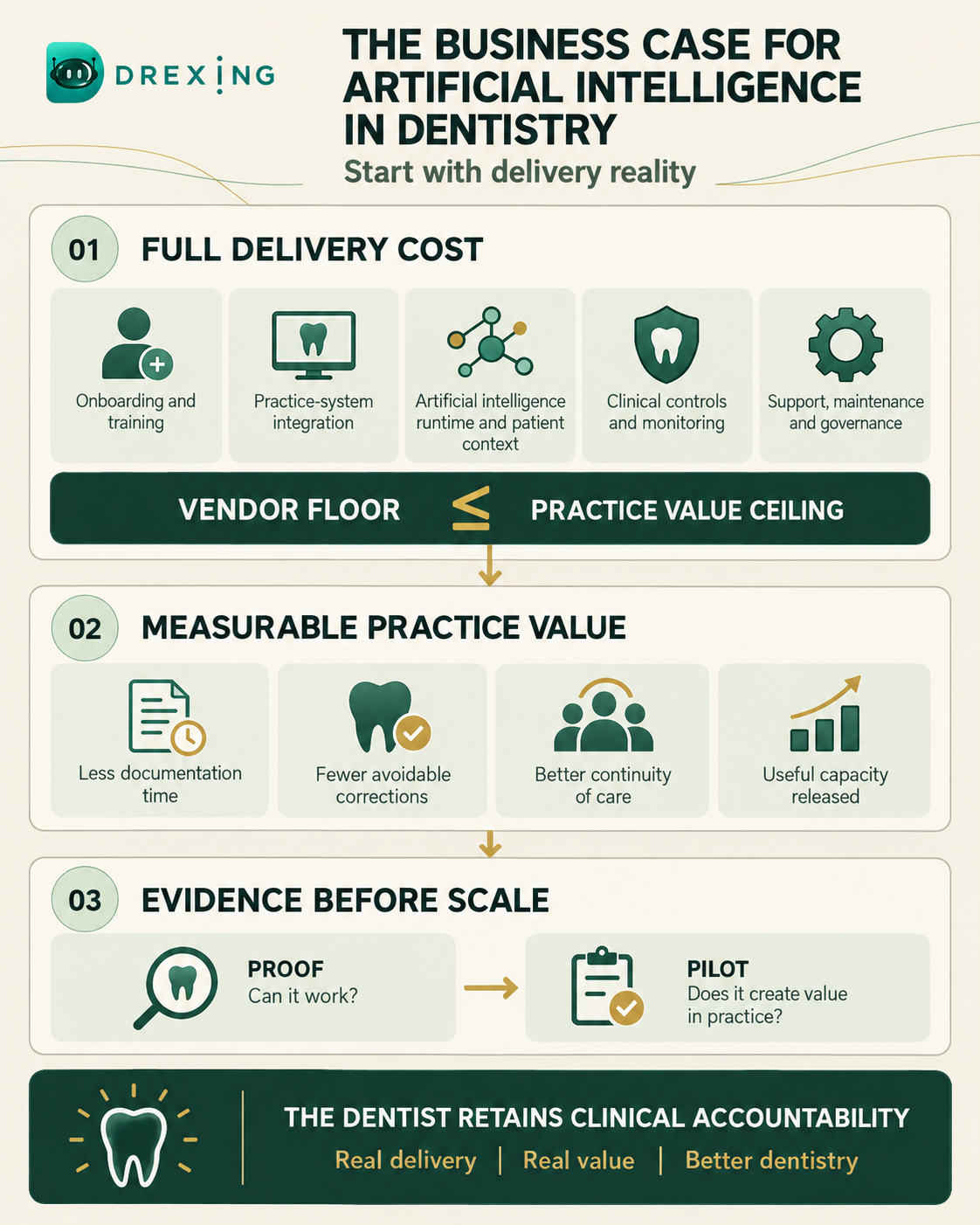
A bottom-up model includes practice onboarding, team training, integration with practice systems, infrastructure, artificial-intelligence usage, patient-context retrieval, clinical controls, monitoring, support and maintenance.
A generated note may have a low inference cost but a higher delivery cost. It still needs authorised context, validation, traceability and clinician review before it can become part of the clinical record.
Runtime cost also changes with appointment volume, transcript length, retrieved history, model selection, retries and evidence requirements.
Separate cost from value
A strong cost-benefit analysis distinguishes between the vendor floor and the buyer value ceiling.
The minimum sustainable price after delivery costs and margin.
The practice's attributable benefit after risk and overlap.
If the vendor floor exceeds the practice's credible value ceiling, the proposition is not ready to scale. Cost, scope or evidence must improve.
Dental benefits must also be treated honestly. Time released from documentation is not automatically cash saved. Reduced rework, better continuity and coding support may overlap, so they should not be counted repeatedly. Quality and assurance can be valuable without being presented as immediate revenue.
Replace assumptions with evidence
A bounded Drexing launch can use a proof of concept when technical uncertainty remains, followed by a live pilot in the practice.
The proof asks: Can Drexing work with the required systems and workflow?
The pilot asks: Does it improve documentation, reduce avoidable rework or release useful capacity without weakening clinical control?
Recurring commercial commitments should follow evidence and acceptance.
Governance belongs inside the calculation. The dentist remains accountable for clinical decisions, so human approval, provenance, monitoring and safe fallback are delivery requirements. They carry cost, but they also protect patients, professionals and practice value.
Yet demanding complete certainty before adoption can delay learning and overlook benefits that only emerge in real practice. Drexing therefore starts safely, measures continuously and scales progressively rather than waiting for perfect evidence.
A useful Drexing cost-benefit analysis is therefore a decision system, not a sales spreadsheet. It determines what should enter a pilot, what needs redesign and what is genuinely ready to scale across dental practices.